 Walter Adkins, Dispatch Operation Manager ·
If you own a security guard company, dispatch is the job nobody notices until it fails: a no-show at 6 a.m., a client calling at midnight, an officer who cannot reach anyone. This guide compares the two ways to run it, an in-house desk and a remote dispatch service, using public government wage data that you can re-run with your own numbers.
Is remote guard dispatch cheaper than an in-house dispatch desk?
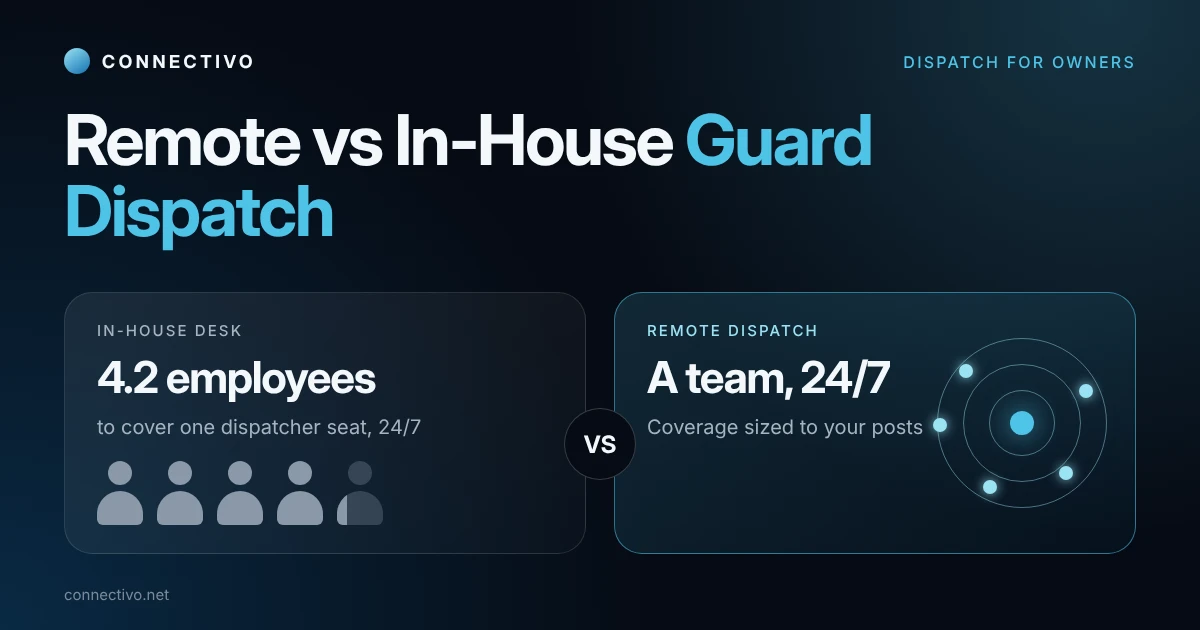
A remote guard dispatch service is often cheaper than an in-house desk because covering one seat 24/7 takes about 4.2 full-time employees (168 hours a week ÷ 40), and you pay their wages, benefits and turnover whether or not the phones ring. Remote dispatch replaces that fixed payroll with coverage sized to your posts.
Guard dispatch is the work of keeping every post covered: reminding officers before a shift, confirming they arrived, finding cover when someone calls out, and escalating incidents to the right person. Someone has to do it at 2 a.m. on a Sunday as reliably as at 10 a.m. on a Tuesday. That “someone” is the cost this guide is about.
Remote dispatch vs in-house dispatch, side by side
Here is how the two models differ on the points that decide whether a guard company stays profitable. One disclosure first: Connectivo runs a remote dispatch service, so we have a stake in this question. That is why the cost figures in the next section come from public government data, not from us.
| What matters to an owner | In-house dispatch desk | Remote dispatch service |
|---|---|---|
| Cost structure | Fixed payroll: wages, payroll taxes, benefits and paid time off for every dispatcher, busy or quiet | Coverage sized to your posts and call volume, so cost moves with your business |
| Nights, weekends, holidays | The hardest seats to fill; needs extra hires or overtime | Built in: a dispatch team works 24/7 |
| Time to start | Recruit, hire, train, equip | Share your posts and escalation rules, then test it free on up to 5 posts for 7 days |
| When a dispatcher is sick or quits | A gap on the desk, or a manager covers it | The team absorbs it; no single point of failure |
| Turnover | Every exit means recruiting again, and knowledge leaves with the person | Your rules are written down and followed by the team, not held in one person’s head |
| Growing or shrinking | Add 20 posts, add people. Lose a contract, keep the payroll | Coverage follows your post count |
| Tools | You choose, buy and maintain the software and phone setup | Dispatch runs on the Connectivo Automated dispatch app |
| Owner’s time | You hire, schedule, coach and replace dispatchers | Your time goes to clients and officers |
| Knowing your sites | A long-serving dispatcher may know every site by heart | Depends on clear post orders and escalation rules (see “When in-house dispatch still makes sense”) |
How to read this table. Remote dispatch is stronger on cost flexibility, overnight coverage and speed to start. In-house is stronger on one thing: a person in your building who knows your sites without being told. Good post orders close most of that gap.
Why “fixed vs flexible” matters most. An in-house desk costs the same in a slow week as in a busy one. A guard company’s revenue does not. When a contract ends, payroll for the desk does not end with it.
What a 24/7 in-house dispatch desk really costs
A week has 168 hours. One employee works about 40 of them. So keeping a single dispatcher seat filled around the clock takes at least 4.2 people (168 ÷ 40), and that is before anyone takes a vacation, calls in sick or quits.
Here is the cost of that one seat, built only from public numbers you can check.
The inputs
- Dispatcher wage. The U.S. Bureau of Labor Statistics (BLS) wage data for 2025 lists a median of $24.20 an hour for dispatchers other than police, fire and ambulance. The 10th percentile is $17.32 and the 90th is $37.57. BLS does not publish a separate figure for security dispatchers, so this is the closest official category. (O*NET OnLine, BLS 2025 wage data)
- Employer cost on top of wages. In June 2026, BLS measured the hourly cost of office and administrative support workers in private industry at $36.73, of which $25.22 was wages and $11.51 was benefits such as paid leave, insurance, retirement and legally required costs. That is about 46 cents of benefits for every wage dollar, or a multiplier of 1.456. (BLS Employer Costs for Employee Compensation, Table 4)
- Hours to cover. 168 hours a week × 52 weeks = 8,736 hours a year.
The formula
Annual cost of one 24/7 seat = 8,736 hours × hourly wage × 1.456
The result
| Wage scenario | Hourly wage | Estimated employer cost per hour | One 24/7 seat, per year (about) |
|---|---|---|---|
| Lower end (10th percentile) | $17.32 | $25.22 | $220,000 |
| Typical (median) | $24.20 | $35.24 | $308,000 |
| Higher end (90th percentile) | $37.57 | $54.72 | $478,000 |
At the median wage, that is roughly $25,700 a month for one seat before you have bought any software or paid for a manager.
If you only need overnight cover, 12 hours a night is 4,380 hours a year. At the median wage that is about $154,000, and you still have to hire people willing to work nights.
What this number leaves out
- Dispatch software, phone lines and a backup if the internet goes down
- Recruiting, background checks and training for every new hire
- Overtime and night or weekend pay differentials
- A supervisor who reviews the dispatcher’s work
- A second seat for the days when two things go wrong at once
- Replacing the person who quits, and the weeks it takes a new person to learn your sites
These costs are easy to miss, because they never appear on one line of the budget.
A note on accuracy. The wage and the benefit multiplier come from two different BLS surveys, and the multiplier is for the broader office and administrative group, not for security dispatchers specifically. Treat the result as a realistic estimate for planning, not as an exact figure for your payroll. Replace the wage with what you actually pay and the result updates.
Run your own numbers
- Your dispatcher hourly wage: $____
- Multiply by 1.456 (or use your real payroll-cost multiplier): $____ per hour
- Multiply by the hours you must cover each year (8,736 for 24/7): $____ per year
- Add software, phone, training and supervision: $____ per year
- Compare that total with a written remote dispatch quote for the same hours.
How remote dispatch changes the cost structure
Remote dispatch does not make dispatch free. It changes what kind of cost it is. Here are the four changes that matter for a guard company’s margin.
1. A fixed cost becomes a flexible one. An in-house desk is payroll you carry every month. A remote service is sized to the posts and hours you actually run. Win a contract and coverage grows with it. Lose one and the cost shrinks with it.
2. You stop paying for quiet hours. A dispatcher you employ is on the clock at 3 a.m. whether 2 posts or 20 need attention. A remote team is shared across many companies, so no single company carries the whole cost of being awake at night.
3. Problems are found while they can still be fixed. A no-show discovered at shift start becomes a client complaint. A no-show discovered about an hour earlier, during a reminder call, gives someone time to find cover. Connectivo’s dispatchers call officers about an hour before each shift for this reason. An hour is enough to solve a problem. Ten minutes is not.
What we see most often. In our own dispatch work, the no-shows we deal with most often have personal causes: a car that breaks down, or an officer who is sick. A car that will not start or a sudden illness usually comes up at the last minute, so the reminder call matters. It gives the officer a chance to say so while there is still time to find cover. This is our own experience, not a national statistic.
4. A desk weighs most on smaller companies. The smaller your company, the more a dispatch desk weighs on every hour you sell. The table below spreads the $308,000 median-wage estimate from the previous section across two sizes of company. This is arithmetic with round example numbers, not Connectivo data.
| Example company | Post-hours covered per year | In-house 24/7 seat cost per post-hour |
|---|---|---|
| Smaller (about 6 posts staffed around the clock) | 50,000 | about $6.16 |
| Larger (about 23 posts staffed around the clock) | 200,000 | about $1.54 |
A smaller company pays four times more dispatch cost per hour it sells than a larger one, for the same one-seat desk. That is the core reason remote dispatch tends to fit small and mid-size guard companies first.
What remote dispatch does not change. You still own your client relationships, your officers, your post orders and your decisions on pay and discipline. A dispatch team follows your rules. It does not replace your management.
When in-house dispatch still makes sense
Remote dispatch is not the right answer for every company. An honest comparison should say when it is not.
An in-house desk can be the better choice when:
- You run enough posts to keep a full desk busy on every shift, so the seat is rarely idle.
- A client contract requires an on-site control room or a named in-house contact. Read your contracts before you decide.
- You already have a stable, trained dispatch team that runs well and rarely turns over.
- You also provide alarm or video monitoring. Those are separate services from guard dispatch, and some states license them separately.
A middle path: keep one in-house coordinator for daytime client relations, and use remote dispatch for nights, weekends and holidays, the hours that are hardest and most expensive to staff.
Is remote dispatch worth testing for your company?
- You find it hard to staff nights, weekends or holidays
- You or your operations manager take dispatch calls after hours
- Call-outs and late arrivals are often found too late to fix
- You plan to add posts in the next 12 months
- You have, or can write down, post orders and escalation contacts for each site
- A full-time desk would be idle for part of the week
Rule of thumb: if three or more of these describe you, a trial is worth your time. A free 7-day test on up to 5 posts lets you see how your own posts would run.
Frequently asked questions
How much does a 24/7 in-house dispatch desk cost?
Using the BLS 2025 median wage for dispatchers ($24.20 an hour) and a benefits multiplier of 1.456 from BLS June 2026 data, one seat covered around the clock costs about $308,000 a year. The range runs from about $220,000 to $478,000 depending on local wages. It excludes software, training, supervision and overtime.
How many people does it take to cover one dispatcher seat 24/7?
At least 4.2 full-time employees, because a week has 168 hours and one employee works about 40. In practice you need more, to cover vacations, sick days and turnover.
Can a remote dispatch team learn my sites?
Yes. A remote team works from your post orders and escalation rules, so clear, current post orders matter more than where the dispatcher sits. Here is how setup works.
What happens when an officer does not show up?
The reminder call about an hour before the shift is designed to surface the problem early. From there the dispatch team follows your escalation rules to find cover and inform the people you name.
Why do security guards miss shifts?
In Connectivo’s dispatch experience, the no-shows we see most often have personal causes, such as car trouble or illness. This comes from our own dispatch work, not from a national study. It is one more reason to call officers before the shift: the officer can tell someone there is a problem while the post can still be covered.
Will I lose control of my officers or my clients?
No. You keep client relationships, pay, discipline and every final decision. A dispatch team follows the rules you set. It does not replace your management. Read more about outsourcing guard dispatch with Connectivo.
Is remote dispatch only for small companies?
It fits small and mid-size companies first, because one fixed desk weighs most on a smaller company’s cost per hour. Large companies with enough posts to keep a desk busy on every shift may reasonably keep dispatch in-house.
Can I try it before committing?
Yes. Connectivo offers up to 5 posts dispatched free for 7 days, so you can see how your own posts would be dispatched.
What is the Connectivo Automated dispatch app?
It is the dispatch application Connectivo’s team uses to run guard dispatch for security companies across the USA.
Sources
- U.S. Bureau of Labor Statistics, Occupational Employment and Wage Statistics, 2025 wage data for Dispatchers, Except Police, Fire, and Ambulance (SOC 43-5032), as published by O*NET OnLine: onetonline.org/link/localwages/43-5032.00. Median $24.20; 10th percentile $17.32; 90th percentile $37.57 per hour.
- U.S. Bureau of Labor Statistics, Employer Costs for Employee Compensation, June 2026, Table 4, office and administrative support occupations in private industry: bls.gov/news.release/ecec.t04.htm. Total $36.73; wages $25.22; benefits $11.51 per hour worked.
- U.S. Bureau of Labor Statistics, Employer Costs for Employee Compensation news release, September 9, 2026: bls.gov/news.release/ecec.nr0.htm.
- Calculations in this article (168 ÷ 40, 8,736 hours, the 1.456 multiplier and every result) were run by Connectivo from the figures above and can be reproduced with the formula in the cost section.
Connectivo is a remote guard dispatch team working 24/7 for security companies across the USA. Want to see how your own posts would run? Get 5 Posts Dispatched Free.